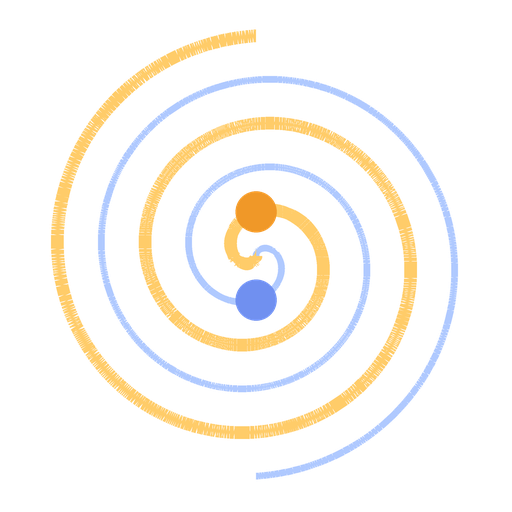

What the mind chooses to entangle with reveals what it is looking for. You become what you consistently attend to. Attention is how the world enters us. We fill every available moment with sound, motion, and other people’s lives because silence forces the one encounter we keep postponing. The encounter with ourselves. This domain is interested in what the mind does with what it cannot resolve.
Curiosity is one of the purest expressions of attention. We pay attention to what we are curious about and what we are curious about speaks volumes about the functioning of our mind. This is a room to examine what it means to follow a question without knowing where it leads. It is an intellectual disposition that treats not knowing as an invitation rather than a deficiency.
There is a particular kind of recognition that happens when you meet your reflection in another person. A person who is not a copy but your flip side, who is the same frequency in a different form. When you meet them, you see yourself from an angle that was never available to you alone. That is a conjunction. Connection is everywhere but resonance is rare.
Many psychological traditions describe the mind not as a unified voice but as a negotiation between competing forces. Freud’s structural model names what most of us sense but rarely examine directly. This domain is an inquiry into defence mechanisms, the ego’s unconscious strategies for managing anxiety. Repression, projection, sublimation, each a way of covering something the mind cannot yet bear to see directly.
The mind becomes cathected to objects, and when the object is lost, the energy does not automatically withdraw. That withdrawal is what mourning actually is. When that investment cannot be withdrawn, the mind remains entangled. Repetition compulsion is one way that unresolved entanglement returns, recruiting new people and new situations to replay an old conflict, driven by an unconscious hope that this time the outcome will be different. The mind ruminates, preventing the solution from arriving by staying in a loop.
A mind can exist in a loop of curiosity. We live a thousand lives within one lifetime and there are countless versions of us that all live inside our mind. There’s a five-year-old curious child with endless questions sharing her point of view with the fifteen-year-old version who is furious at injustice, pulling at the threads of a world that punishes people for speaking up. There’s a twenty-two-year-old version who is asking the stars what any of it means. Then there is a thirty-year-old who still cannot stop asking, and has stopped pretending that she should stop.
Here, the questions are different. Who decides when you think you are deciding? Which inner voices are actually arguing? What occupies the mind long after it has ceased to serve it? Why do some people become lifelong companions while others remain passing encounters? And what pattern beneath a particular person, belief or failure quietly keeps recreating the same unresolved conflict?
Citations: Freud, S. Beyond the Pleasure Principle (1920), Standard Edition Vol. 18. The Ego and the Id (1923), Standard Edition Vol. 19. Anna Freud, The Ego and the Mechanisms of Defence (1936). John Bowlby, Attachment and Loss, Vol. 1: Attachment, Basic Books, 1969.