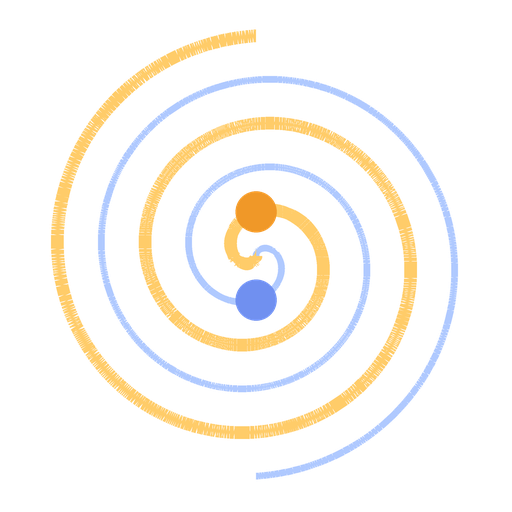

Time
Time is the space where everything unfolds all at once. We do not move through time so much as we experience it from the particular point where we stand, aware only of the slice we occupy. It is the medium everything else occurs in, and we understand it remarkably poorly.
This domain explores our relationship with time in all its strangeness. Why it moves differently depending on what we are doing. How memory reconstructs rather than just records. What it means to live with awareness of impermanence. Why we assume that time is linear. And why we restrict it to move only in forward direction.
But meaning tends to run backwards. The significance of an encounter, a person, a place, an idea, frequently only becomes visible from what came after it. A conjunction that looked ordinary becomes the turning point only in retrospect. The future participates in defining what the past ultimately was. This is backward causality. It describes not only a theory of time but the way most meaningful things actually work. Essays here follow that backwards direction, asking what the ending reveals about the beginning.
The Threshold
A threshold is not a place. It is a condition. The space between one state and another, not the departure, not the arrival, but the crossing itself. This domain is devoted to liminal experience in all its forms: the between-times, the not-yet and no-longer, the states of becoming that resist easy description because they are, by definition, in motion.
Every conjunction creates a threshold. The moment two things occupy the same space, neither is what it was before the meeting. The flip side is a threshold. The moment of recognition is a threshold. The present moment, understood fully, is always a threshold, the only place where what you are and what you are becoming briefly coincide.
Ancient practices understood this long before it had a name. Dhyana, often translated as meditation but not quite contained by that word, is not just about emptying the mind. The thoughts keep arriving, passing through like slides in a carousel. What Dhyana cultivates is the space between them. The held breath is where this becomes visceral. Breathe in, and hold. In that hold, the slideshow pauses. The chaos outside stops. The witness separates briefly from the content of the mind, and for that fraction of a second, you are not your thoughts. You are the one watching them. The threshold reveals itself not as a place to arrive at but as something that was always there, waiting to be noticed.
There is an observation worth making here, an uncomfortable one. A smoker takes a drag and holds. The body stopped reacting to the nicotine long ago. What remains is the ritual of the hold itself. The manufactured pause in the middle of chaos. The nervous system reaching for a threshold because it needs one and has not found another way in. The cigarette and the breath work are not opposites. They are the same longing, expressed differently. We will go to extraordinary lengths to create the stillness. The threshold is not a spiritual luxury. It is a human necessity.
This is the domain most native to this site. If the other nine domains are the territories the garden explores, the threshold is where all of them meet.
Conjunction
If Time is the ocean within which everything moves, then the Threshold is the moment within that movement when you are neither where you were nor where you are going. It is not the absence of movement, but the brief suspension of identity within it. The Īśā Upaniṣad, in its attempt to describe Brahman, the ultimate reality that underlies all existence, arrives at something that perhaps holds equally true for the threshold:
तद् एजति तन् नैजति तद् दूरे तद् व् अन्तिके ।
तद् अन्तर् अस्य सर्वस्य तद् उ सर्वस्यास्य बाह्यतः ॥
tad ejati tan naijati / tad dūre tad v antike / tad antar asya sarvasya / tad u sarvasyāsya bāhyataḥ
It moves and it moves not. It is far and likewise near. It is within all this. It is outside all this.
Within a threshold, does one briefly touch the absolute? Threshold seems to be the one moment within Time when Time itself stops. Perhaps it is not Time that stops, but the self that pauses enough within the movement to actually witness Time, to actually feel it. It is within a threshold that one briefly experiences the suspension of identity. It is impossible to observe Time from a distance, but maybe within a threshold, Time is actually sensed, from the stillness at its centre, the way you feel a river’s current only when you stop moving with it.
Citations: Īśā Upaniṣad 5. Rendering follows widely circulated English translations.
-
Phases
Four poems. Her Sun (July 8, 2016), Tough Love (May 30, 2018), Sunshine (December 20, 2018) and प्रकाश (November 29, 2025).
-
Just
A poem about the word that keeps returning.
-
On Writing and the Block
I have gotten to a point where I sit down and note thoughts in bullet points. Random thoughts, no structure, no punctuation, no caring about flow. I dealt with the writing block by deciding these were notes and not real writing. That freed the flow. Now the project is asking me to write-write. And I’m…