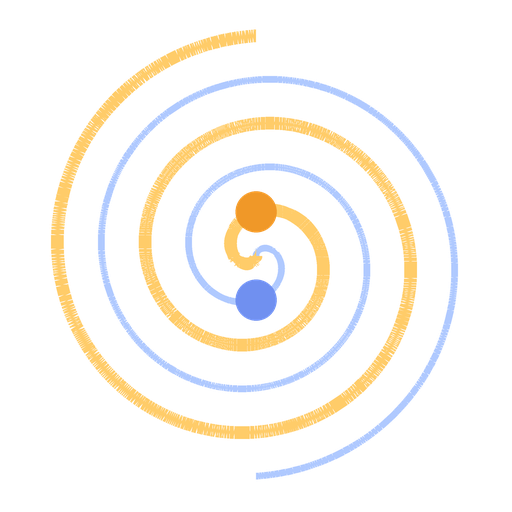

The spiral of a galaxy and the spiral of a hurricane are both logarithmic spirals, produced by entirely different physical forces arriving at the same form. The Fibonacci sequence is one of the most striking instances of this pattern, appearing in nautilus shells, sunflower seeds, and phyllotaxis simultaneously. Neural networks and star maps are uncannily alike. Vedic cosmology and abiogenesis are asking the same question in different languages. The universe, it seems, signs its work the same way at every scale. The signature appears in fractals, in the golden ratio, in the geometry of a fern that looks like the whole fern, in a river delta that looks like a circulatory system. The same pattern, repeated endlessly, from the quantum realm to the galactic.
And then there is Cymatics. Sound frequencies create geometric patterns in matter. The same frequency produces the same shape, every time, regardless of the medium. Sand, water, metal, all respond to the same vibration the same way. Which makes one wonder: if pattern follows frequency, and frequency is everywhere, what is the universe actually made of?
String theory proposes that the fundamental constituents of reality are vibrational strings rather than point-like particles. Not matter. Not particles. Vibration. Ancient mythologies arrived at something remarkably similar, long before physics did. The Damaru, the cosmic drum of Mahakaal, is said to produce the first ripple from which all of reality unfolds. Devi, the primordial force, the symphony of constant motion, animates what Mahakaal holds still. Together they suggest a cosmic dance, a rhythm underlying everything that exists. Whether this is metaphor, mythology, or something closer to physics than we have yet understood, is precisely the kind of question this domain exists to ask. It is all just vibration. It may all just be music.
Yet not every remarkable pattern belongs to mathematics and physics alone. Beneath a forest floor, vast mycorrhizal networks connect trees across entire ecosystems, transferring nutrients, relaying warnings of stress, and redistributing resources through a living web with no central controller. They challenge familiar categories. They are neither conscious in any recognisable sense nor merely inert matter. They suggest that organisation, communication and adaptation can emerge across an entire living system without residing in any single organism.
This domain explores the intelligence embedded in non-human systems, from the quantum realm to the galactic, from fungal networks beneath a forest floor to the geometry of a galaxy’s arms. But more than that, it explores what it means for a conscious being to be able to notice these patterns at all. The universe is not merely unfolding. It is watching. Experiencing itself through everyone who stops to truly witness. Essays here ask what it means to be that witness.
Citations: Fibonacci sequence, logarithmic spirals and phyllotaxis: D’Arcy Wentworth Thompson, On Growth and Form, Cambridge University Press, 1917; Ian Stewart, Nature’s Numbers, Basic Books, 1995. Cymatics: Hans Jenny, Cymatics: A Study of Wave Phenomena and Vibration, Basilius Presse, 1967.The Damaru as source of primordial sound: a tradition recorded across Shaivite literature, including the Shiva Purana (a living text in multiple manuscript versions, earliest surviving manuscripts c. 10th–11th century CE; Bibek Debroy translation, Penguin, 2014). The most precisely citable form: the Maheshvara Sutras, the fourteen phoneme-organizing aphorisms named within the Ashtadhyayi tradition as having emerged from Shiva’s fourteen beats of the damaru at the conclusion of the Tandava. Pāṇini, Ashtadhyayi (Aṣṭādhyāyī), c. 400 BCE; English translation by S.M. Katre, University of Texas Press, 1987. Note: the Maheshvara Sutras are a pre-text to the grammar proper, organizing Sanskrit’s phonemes before the rules begin. Nada Brahma, the world as sound: documented across Shaivite philosophical literature. Devi as primordial kinetic force: Shakta tradition; Devi Bhagavata Purana. Mycorrhizal networks, nutrient transfer and chemical signalling between trees: Suzanne Simard et al., “Net Transfer of Carbon Between Ectomycorrhizal Tree Species in the Field,” Nature, Vol. 388, 1997; Suzanne Simard, Finding the Mother Tree, Allen Lane, 2021.
-
On Fascination
“They say they can’t see in the dark. I see a little more at night.” – written sometime around 2013. The fascination with the night sky, for me, has always been beyond ordinary. Whether it was crying as a toddler to sleep under the stars instead of in the comfort of my cosy room, asking…
-
Gravity
As a five-year-old, sitting in the backseat of the car, I looked up at the moon as a celestial body moving alongside me, everywhere I went. Even at the highest speeds, it felt like it was on the journey with me. It has looked over me for decades. I have been in love for as…